
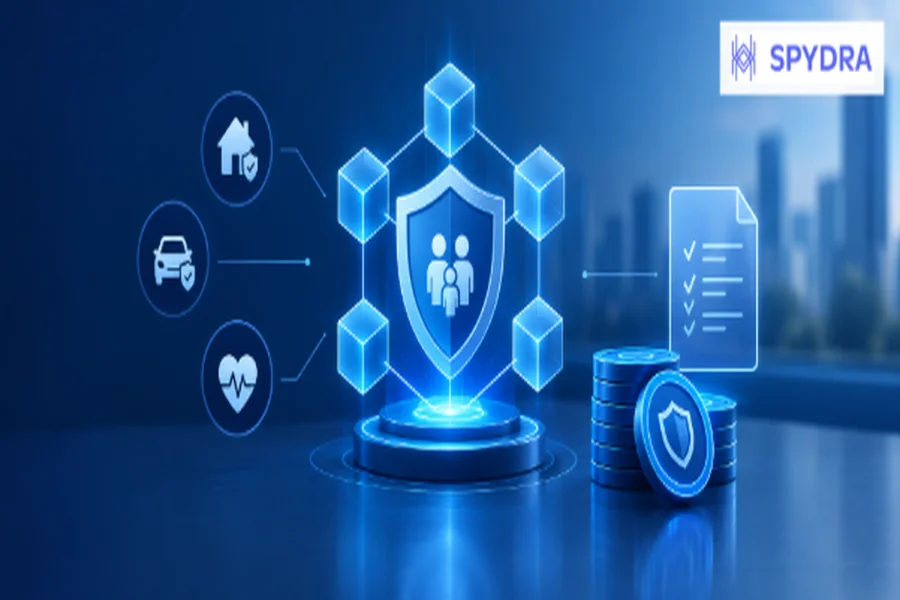
Insurance Tokenization Platforms: A Guide to Blockchain-Powered Insurance
Insurance runs on information shared between parties that rarely share systems. An insurer, a broker, a reinsurer, and several service providers may each keep their own version of a policy record, a claim file, or a risk-sharing arrangement. The result is fragmented records, repeated reconciliation, limited data interoperability, and administrative overhead that grows with every additional participant.
Insurance tokenization platforms are blockchain-enabled infrastructure that can represent eligible insurance-related rights, interests, or assets as digital tokens and support programmable workflows, depending on the product’s legal and technical design. Used well, a shared permissioned ledger can improve record traceability, coordination between authorized participants, and execution of predefined processes.
The limits matter as much as the promise. Tokenization alone does not eliminate fraud, guarantee faster claims, remove intermediaries, or ensure regulatory compliance. This guide covers how the technology works, where it applies, what can go wrong, and how to evaluate platforms, so enterprises can decide whether and where it fits before they commit to implementation.
What Are Insurance Tokenization Platforms?
Insurance tokenization platforms combine blockchain infrastructure, digital token issuance, smart contracts, permissions, and workflow automation. They let an organization define what a token represents, control who can hold or transfer it, and record lifecycle events on a shared ledger.
Insurance tokenization means creating digital representations of eligible insurance-related rights, interests, or assets, subject to applicable law. Depending on the structure, these may include:
- Interests in insurance-linked investment instruments
- Participation in a risk-sharing or reinsurance arrangement
- Records linked to policies, insured assets, or claims workflows
How it differs from digitizing policy documents
Scanning a policy or storing it in a document system is digitization. Tokenization goes further by creating a controlled digital representation with rules about holders, transfers, and permitted actions. Many insurance workflows need only the former.
How it differs from conventional policy administration software
Policy administration systems manage underwriting, billing, and servicing within one organization. A tokenization platform is shared infrastructure for recording and coordinating across multiple parties. The two are complementary, and neither replaces the other.
Why legal agreements still come first
A blockchain record does not independently establish legal ownership or guarantee an enforceable insurance claim. Rights come from contracts, licensed entities, and the governing law. Not every policy needs to be tokenized, and many should not be.
Example: An insurer, a broker, a reinsurer, and two authorized service providers want a single, permissioned record of selected risk-sharing data and lifecycle events. Each participant gets role-based access. The agreed business rules are encoded in smart contracts, while the contracts between the parties remain the legal source of obligations. The ledger reduces duplicate record-keeping and makes changes traceable. It does not replace the underlying agreements.
How Insurance Tokenization Works
A typical implementation follows these steps:
- Identify the insurance use case. Decide whether the goal is representing insurance-linked assets, coordinating policy-related records, supporting risk participation, or automating predefined processes.
- Define the legal structure. Establish rights, obligations, participants, and regulatory requirements.
- Verify participants. Integrate identity verification, eligibility checks, and access controls where required.
- Design the digital representation. Define what a token represents, who can hold it, and which transfers or actions are permitted.
- Configure smart contracts. Encode approved business rules, conditions, and transaction restrictions.
- Integrate trusted data sources. Connect authorized internal systems and validated external data where the workflow needs them.
- Manage transactions and reporting. Maintain records, monitor lifecycle events, and support reconciliation and auditability.
Smart contracts execute configured logic. They do not independently interpret policy language, verify every real-world event, or resolve disputed claims. Those functions still depend on defined data sources, governance, and human judgment.
Key Benefits of Insurance Tokenization
In suitable workflows, blockchain insurance approaches can offer:
- Improved traceability of transactions and authorized record changes
- More efficient coordination between participating organizations
- Programmable handling of predefined business rules
- Potentially reduced manual reconciliation, where multiple parties maintain parallel records
- Better visibility into selected insurance-linked asset records
- More structured digital administration of eligible risk-participation arrangements
- Integration opportunities with enterprise systems and data sources
- Improved audit trails for activities recorded on the blockchain
These outcomes are not automatic. They depend on system architecture, adoption by participants, data quality, governance, and integration with existing insurance operations. Tokenization does not guarantee savings, instant settlement, universal transparency, or the elimination of operational risk.
Major Use Cases of Insurance Tokenization Platforms
Parametric Insurance
Parametric insurance pays according to predefined, measurable conditions, such as a rainfall level or a catastrophe indicator, rather than relying solely on conventional loss adjustment. This is where parametric insurance blockchain designs attract the most interest.
Smart contracts and validated external data feeds can support payout calculations when contractual triggers are met. For example, a weather-related agricultural policy might define a rainfall threshold over a set period, with the contract calculating a payout when verified data crosses it.
The technology supports the calculation. It does not remove the importance of policy terms, data validation, exceptions, and applicable law. If the data source is wrong or disputed, the outcome will be too.
Reinsurance and Risk Participation
Blockchain-based systems may support administration of eligible risk-participation arrangements, improve transaction traceability, and coordinate information among insurers and reinsurers. Reinsurance tokenization is relevant only where the underlying legal and financial structure permits it.
Tokenization does not automatically transfer insurance risk or make a reinsurance agreement enforceable. The agreement and applicable regulation do that. The platform’s role is administrative: recording, coordinating, and applying agreed rules.
Insurance-Linked Securities
Eligible interests associated with insurance-linked securities may be represented digitally, subject to securities laws, offering documents, and the transaction structure. Insurance-linked securities tokenization may offer operational advantages in recordkeeping, reporting, and transfer administration, for example by maintaining a consistent record of holders and permitted transfers. The legal characterization of the instrument stays the same whether or not it is tokenized.
Claims Processing and Settlement Workflows
Blockchain can coordinate approved data, transaction records, and predefined workflow steps among authorized parties. This is insurance claims automation, which is a different thing from tokenization. A claims workflow can use a shared ledger without any token being issued.
Coverage interpretation, exclusions, disputes, and human review may still be necessary. Automation is most credible for well-defined, rules-based steps and least credible for complex or contested claims.
Property and Commercial Insurance
Digital asset records and insurance workflows may be coordinated for commercial buildings, industrial facilities, logistics assets, and other insured property. Where a property is also tokenized, a platform could help link asset records, policy documentation, and reporting.
This relates to real estate asset tokenization but is a separate use case. Tokenized property does not automatically include insurance coverage, and insuring a tokenized asset still requires a conventional insurance arrangement.
Insurance Tokenization vs. Traditional Insurance Digitization
| Evaluation criterion | Traditional insurance digitization | Blockchain-based insurance tokenization |
| Recordkeeping | Each organization maintains its own system of record | Shared, permissioned ledger among authorized participants |
| Multi-party coordination | Integrations and reconciliation between separate systems | Common record and workflow across participants |
| Programmable business rules | Rules in application code within one organization | Rules encoded in smart contracts visible to participants |
| Representation of eligible financial or contractual interests | Database entries within an institution’s systems | Digital tokens with defined holders and transfer rules |
| Auditability | Audit logs within each system | Shared audit trail for on-chain activity |
| Integration requirements | Integration with internal and partner systems | Blockchain integration plus links to existing systems |
| Regulatory and legal considerations | Established regulatory treatment | Added questions on token classification, enforceability, and transfers |
Conventional digitization can already deliver substantial operational improvements, and for many single-organization workflows it is the better choice. Blockchain tends to add value when shared records, controlled transactions, or coordination across multiple independent parties provide a clear advantage. It is not universally superior.
Features to Look for in Insurance Tokenization Software
Enterprise buyers evaluating insurance tokenization software should look for:
- Configurable digital asset and token issuance that fits the structure in question
- Permissioned access and participant governance with defined roles
- Smart contract development and lifecycle management, including versioning and updates
- Identity verification and eligibility integrations
- Transfer restrictions and transaction authorization
- Data privacy and confidentiality controls for sensitive policy and counterparty data
- API integrations with insurance administration and enterprise systems
- Audit trails, reporting, and monitoring
- Security testing and smart contract auditability
- Scalability and operational support
- Flexible deployment architecture
- Extensibility for asset tokenization and adjacent enterprise workflows
Technical functionality is only part of the decision. Legal suitability, interoperability, governance, and implementation complexity deserve equal weight, because a technically capable platform can still be the wrong fit for a given product or jurisdiction.
How to Choose an Insurance Tokenization Platform
Work through these steps in order:
- Define the business problem and expected outcomes.
- Identify the specific insurance-related rights, assets, or workflows involved.
- Assess the legal structure and regulatory requirements.
- Evaluate blockchain architecture, permissions, and privacy.
- Review smart contract capabilities and security controls.
- Check integrations with existing policy, claims, and reporting systems.
- Assess data quality, external data dependencies, and governance.
- Estimate implementation costs and ongoing maintenance.
- Run a limited proof of concept before enterprise-wide deployment.
| Selection criterion | Questions to ask vendors | Why it matters |
| Use-case fit | Which structures and workflows does the platform support today? | Avoids forcing a use case into an unsuitable tool |
| Legal alignment | How are rights, transfer rules, and eligibility controls configured? | Digital rules must reflect legal agreements |
| Architecture and privacy | How are access, data segregation, and confidentiality handled? | Insurance data is sensitive and often commercially confidential |
| Smart contract security | What testing, audit support, and upgrade processes exist? | Code errors can create financial and legal exposure |
| Integrations | What APIs and connectors link to policy, claims, and reporting systems? | Isolated platforms create duplicate work |
| Data governance | How are external data sources validated and disputes handled? | Automated outcomes are only as reliable as their inputs |
| Cost and maintenance | What are implementation scope, timeline, and ongoing costs? | Prevents budget and timeline surprises |
| Proof of concept | Can a limited pilot validate assumptions first? | Reduces risk before wider rollout |
Selecting a blockchain network is not the same as selecting a platform. The network provides the ledger, while a platform adds issuance workflows, participant controls, integrations, and operational support.
Insurance Tokenization and Regulatory Compliance
Insurance is a regulated sector, and tokenization adds a second layer of questions. Product and jurisdiction both need careful assessment. Enterprises should evaluate:
- Insurance licensing and product regulation
- Securities laws where tokens represent investment interests
- Contractual enforceability and policyholder rights
- KYC/AML and investor eligibility where applicable
- Data privacy and confidential information
- Cybersecurity and smart contract risk
- Custody, transfer restrictions, and recordkeeping
- Cross-border transactions and jurisdictional differences
A blockchain platform can support compliance-oriented controls such as eligibility checks, approval workflows, and audit trails. It does not independently make an insurance product compliant, and it does not replace legal advice, licensed entities, regulatory approvals, or established governance processes. Requirements differ by country and structure, so legal review should begin before technical design.
Challenges and Risks of Insurance Tokenization
- Unclear legal rights represented by tokens. Mitigation: Define rights in the governing documents first, then design the token to reflect them.
- Integration with legacy systems. Mitigation: Map data flows early and use APIs and phased integration rather than wholesale replacement.
- Inaccurate or manipulated external data. Mitigation: Use validated, authorized sources, define fallback procedures, and agree on dispute processes.
- Smart contract vulnerabilities. Mitigation: Apply staged testing, independent audits, and controlled upgrade procedures.
- Data privacy and confidentiality concerns. Mitigation: Keep sensitive data off-chain where appropriate and use permissioned access with role-based visibility.
- Fragmented standards and limited interoperability. Mitigation: Prefer open, well-documented architectures and confirm how systems exchange data.
- Governance across insurers, reinsurers, brokers, and service providers. Mitigation: Agree on participation rules, decision rights, and dispute handling before launch.
- Uncertain commercial benefits where shared infrastructure is not needed. Mitigation: Test the business case in a limited proof of concept and proceed only where multi-party coordination delivers clear value.
How Spydra Supports Enterprise Asset Tokenization
Spydra is an enterprise-grade, low-code blockchain platform for real-world asset tokenization. Its positioning is relevant for organizations that are exploring insurance-linked assets or related financial workflows and want to assess an asset tokenization platform as one component of a broader architecture:
- Enterprise-focused asset tokenization infrastructure designed for business use
- Hyperledger Fabric-based permissioned architecture, which supports controlled access and defined participant roles
- Configurable tokenization workflows, which a low-code approach can make faster to adapt than custom builds
- Private and public blockchain deployment options, where supported by the relevant solution
- Compliance-oriented workflow design, reflecting onboarding, approval, and transfer-control needs
- Applicability across asset classes, including real estate and other real-world assets
It is important to be precise about scope. Asset tokenization infrastructure is not a complete insurance policy administration, underwriting, or claims management system. In an insurance context, it would typically sit alongside those systems, handling issuance, permissions, and recordkeeping for tokenized assets and shared workflows. Any insurance-specific integration, regulatory position, or product capability should be confirmed directly with Spydra during evaluation.
Exploring blockchain-based asset tokenization for your enterprise? Discover Spydra’s platform capabilities and discuss your use case with the team.
The Future of Blockchain-Powered Insurance
The realistic opportunity lies in combining tokenization with programmable workflows, permissioned blockchain networks, interoperable enterprise systems, and validated external data. The strongest candidates are workflows that already involve several independent parties and costly reconciliation, such as risk-participation administration, parametric products with well-defined data triggers, and the recordkeeping of eligible insurance-linked instruments.
Adoption will depend on clear business cases, legal certainty, ecosystem participation, data governance, and measurable operational benefits. Blockchain is unlikely to replace conventional insurance infrastructure. It will more probably be applied selectively, where shared records and controlled coordination justify the added complexity. For enterprises, the practical path is to start with a defined use case, test it in a limited pilot, and expand only if the results support it.
Frequently Asked Questions
1. What are insurance tokenization platforms?
Insurance tokenization platforms are blockchain-based systems that let organizations represent eligible insurance-related rights, interests, or assets as digital tokens and automate predefined workflows. They typically combine token issuance, smart contracts, permissions, and audit trails. Their use depends on the product’s legal structure and applicable regulation.
2. How does insurance tokenization work?
Organizations identify a use case, define the legal structure, verify participants, design what the token represents, and configure smart contracts. They then connect trusted data sources and manage transactions and reporting. Smart contracts execute agreed rules, while legal agreements remain the source of enforceable rights and obligations.
3. What is the difference between insurance tokenization and insurance digitization?
Digitization converts documents and processes into electronic form within existing systems. Tokenization creates controlled digital representations of eligible rights or assets on a blockchain, with defined holders and transfer rules. Digitization is often sufficient for single-organization workflows, while tokenization is most useful when multiple independent parties share records.
4. How can blockchain support insurance claims processing?
Blockchain can provide a shared, auditable record of approved data and workflow steps among authorized parties, and smart contracts can automate predefined steps. It does not interpret coverage, apply exclusions, or settle disputes on its own. Human review and policy terms remain essential, particularly for complex or contested claims.
5. What is the role of smart contracts in parametric insurance?
In parametric insurance, smart contracts can calculate payouts when a predefined, measurable condition, such as a rainfall threshold, is met according to validated data. They automate the agreed formula. Policy terms, data source reliability, exceptions, and applicable law still determine whether and how a payout occurs.
6. Can insurance policies be tokenized?
In some structures, insurance-related rights or records can be represented digitally, subject to law and product design. However, not every policy should or needs to be tokenized. A token does not independently create an enforceable claim, which still depends on the policy contract and the regulated insurer’s obligations.
7. What is reinsurance tokenization?
Reinsurance tokenization applies digital tokens and programmable workflows to eligible reinsurance or risk-participation interests, where the legal and financial structure permits it. It may improve administration and traceability. It does not automatically transfer risk or make a reinsurance agreement enforceable, because those depend on the underlying contracts and regulation.
8. Is insurance tokenization legally permitted?
It depends on the jurisdiction, product, and structure. Insurance licensing, securities laws, contractual enforceability, and data rules may all apply. In some cases it is feasible within existing frameworks, but tokenization does not bypass regulation. Enterprises should obtain legal advice for each specific use case.
9. What features should enterprises look for in insurance tokenization software?
Key features include configurable token issuance, permissioned access, smart contract lifecycle management, identity and eligibility integrations, transfer restrictions, privacy controls, API integrations, audit trails, security testing support, scalability, and flexible deployment. Legal suitability, interoperability, and governance should be evaluated alongside technical capability.
10. How can enterprises evaluate a blockchain platform for insurance-related use cases?
Start with the business problem and the specific rights or workflows involved, then assess legal requirements, architecture, privacy, smart contract security, integrations, data governance, and total cost. Ask vendors detailed questions and run a limited proof of concept before committing to enterprise-wide deployment.
Conclusion
Insurance tokenization platforms offer a way to coordinate records, represent eligible insurance-linked interests, and automate predefined workflows across multiple parties. They are not a universal upgrade over conventional insurance software, and they do not remove legal, regulatory, or data-quality constraints. The most sensible approach is to define the use case and legal structure first, compare platforms against clear criteria, and validate assumptions through a limited pilot. Enterprises that follow this path can judge more reliably where blockchain-powered insurance adds value and where existing systems are enough.