
Industrial Pump Selection for Harsh Fluids: A Practical Field Guide
Table Of Contents
- Why Fluid Properties Matter
- Build a Complete Fluid Profile
- Compare Pump Types Before Choosing
- Choose Materials for the Actual Duty
- Review Seals and Leak Control
- Check Head, Flow, and Suction Conditions
- Plan for Maintenance and Wear
- Avoid Common Selection Mistakes
- Use Modern Tools and Operating Data
- A Simple Final Checklist
Selecting an industrial pump for corrosive chemicals, abrasive slurries, hot liquids, or high-viscosity products requires more than matching a flow rate to a catalog listing. The pump must suit the actual fluid, the piping system, the operating range, and the facility’s maintenance capabilities. For application-specific equipment information, get more details before finalizing a specification.
A sound selection process reduces the risk of premature wear, leakage, unstable flow, excess energy use, and unplanned downtime. The best pump is not automatically the largest or most expensive option. It is the unit whose hydraulics, wetted materials, sealing arrangement, and maintenance needs match the duty it will perform.
Why Fluid Properties Matter
A pump proven on clean water may perform very differently with the process liquid. Viscosity affects how readily fluid moves through passages and piping. Density influences pressure requirements and motor loading. Temperature can change viscosity, vapor pressure, chemical compatibility, and seal behavior. Acidity, alkalinity, dissolved chemicals, and solids can all affect the service life of wetted components.
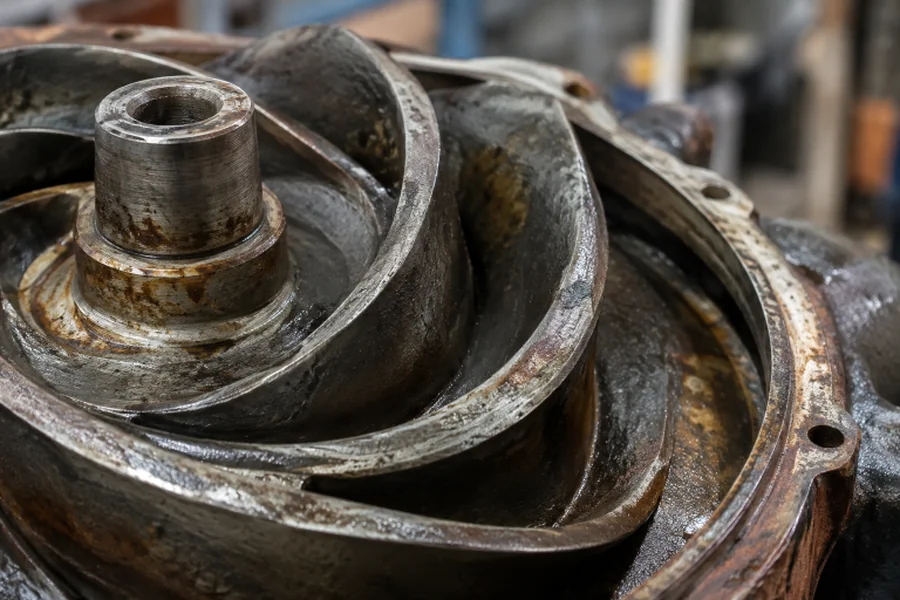
Abrasive particles can erode impellers, casings, liners, and seals. Corrosive fluids can attack metals, elastomers, or plastics that appear suitable at first glance. Even a modest process change, such as a colder startup temperature or higher solids content, can move a pump away from its intended operating condition.
Build a Complete Fluid Profile
Before requesting a recommendation, assemble operating data that reflects normal production, startup, cleaning, and upset conditions. Average values are useful, but the most difficult condition often drives the selection.
- Identify the fluid name, composition, concentration, and any additives.
- Document normal, minimum, and maximum temperatures.
- Provide viscosity at relevant temperatures, especially cold-start conditions.
- Include specific gravity, vapor pressure, and gas content where known.
- Describe solids concentration, particle size, particle hardness, and tendency to settle.
- State the required flow range, discharge pressure, and expected operating hours.
- Note fibers, crystals, debris, air entrainment, or intermittent dry-running risk.
Compare Pump Types Before Choosing
Different pump categories solve different problems. Centrifugal pumps are commonly used where higher flow and relatively stable liquid properties are expected. Positive displacement pumps are often considered for viscous fluids, metering duties, or applications requiring more consistent flow against changing pressure.
Self-priming designs can be useful where air may enter the suction line. Sealless magnetic-drive pumps may be appropriate where leakage control is a primary concern, and the fluid is compatible with the design. Slurry-focused pumps typically feature larger passages and wear-resistant components to handle solids. Selection should address the whole pumping system, since pump systems require coordinated attention to equipment, controls, and energy use, not just the pump itself.
Choose Materials for the Actual Duty
Material selection should consider chemical concentration, temperature, pressure, exposure time, and solids. Stainless steel, higher-performance alloys, engineered plastics, elastomers, ceramics, rubber linings, and coated components each have appropriate uses, but none is universally compatible.
Corrosion, erosion, abrasion, and chemical swelling are separate failure mechanisms. A cool, low-solids chemical may be handled successfully by one material combination, while a hot slurry with sharp particles may require a different casing, liner, impeller, shaft sleeve, and seal arrangement. Confirm compatibility for every wetted component, including gaskets and O-rings.
Review Seals and Leak Control
Seals deserve attention during the first design review. Mechanical seals, cartridge seals, packing, double-seal arrangements, barrier systems, flush plans, and sealless options all involve trade-offs in containment, maintenance, and operating limits.
Temperature, abrasives, pressure variation, dry running, shaft movement, and chemical compatibility can shorten seal life. Ask how a leak will be detected, where leaked fluid will go, and whether the process can safely tolerate a seal failure. A practical seal plan should address both routine operation and abnormal events.
Check Head, Flow, and Suction Conditions
Specify a usable flow range rather than one ideal operating point. Then calculate static head and friction losses through pipe, fittings, valves, strainers, heat exchangers, and elevation changes. Compare the resulting system curve with the pump performance curve, and confirm the motor can handle the expected load.
Suction conditions need equal scrutiny. Available net positive suction head must be suitable for the chosen pump and fluid conditions. Cavitation occurs when local liquid pressure falls below vapor pressure, allowing vapor cavities to form and collapse. Noise, vibration, unstable flow, and repeated impeller damage can indicate a suction or operating-point problem.
Plan for Maintenance and Wear
Evaluate access before purchase. Maintenance teams should be able to inspect or replace seals, bearings, wear parts, impellers, liners, and strainers without unnecessary disruption. Confirm the availability of critical spares and establish inspection intervals based on the real duty rather than a generic calendar.
Routine tracking of vibration, bearing temperature, suction and discharge pressure, flow, and motor load can reveal changing conditions. Repair records are equally valuable because repeated failures often indicate a system issue, such as poor suction piping, unsuitable materials, or operating outside the preferred range.
Avoid Common Selection Mistakes
- Choosing from flow rate alone.
- Using clean-water performance assumptions for thick, corrosive, or abrasive fluids.
- Ignoring cold-start viscosity and maximum temperature.
- Selecting materials from habit instead of compatibility data.
- Overlooking suction piping and available NPSH.
- Operating far from the pump’s intended range.
- Failing to plan for future changes in fluid, throughput, or duty cycle.
Use Modern Tools and Operating Data
Digital sizing tools, variable-speed drives, process instrumentation, and condition monitoring can improve selection and operation when supported by reliable field data. Variable speed can help a system respond to changing demand, while monitoring trends can identify wear or changing process conditions before a failure becomes urgent.
A Simple Final Checklist
- Is the full fluid profile documented for normal and worst-case conditions?
- Are flow, pressure, temperature, and suction conditions confirmed?
- Do wetted materials, elastomers, and seal faces suit the fluid?
- Can the pump handle solids, gas, and viscosity changes?
- Does the performance curve cover the expected operating range?
- Are maintenance access, spare parts, containment, and energy use acceptable?
Reliable pump selection starts with complete process data and a system-level review. When the fluid, pump, piping, controls, and maintenance plan are considered together, facilities are better positioned to reduce leaks, wear, wasted energy, and unplanned downtime.


