
Am I Attractive? Understanding Facial Harmony, Natural Beauty, and Personal Style
Attractiveness is personal, but curiosity about your appearance is entirely natural. If you have ever wondered, “Am I attractive?” an AI attractiveness test offers an interesting way to explore your facial features, proportions, and overall facial harmony.
Quick Answer: How to Check “Am I Attractive?”
Facefy offers an AI-powered approach to exploring your facial appearance through a single photograph. Instead of relying on anonymous opinions or social media comparisons, you can examine measurable characteristics of your face.
With Facefy’s AI Attractiveness Test, you can explore your facial proportions and receive an estimated attractiveness score based on your uploaded image.
The process is straightforward:
- Upload a clear, front-facing photograph.
- Allow the AI to analyze your facial characteristics.
- Review your estimated beauty score and facial analysis.
- Interpret your results within the context of your individual appearance.
Remember that an AI-generated rating reflects the tool’s assessment criteria rather than how attractive everyone finds you.
What Is an AI Attractiveness Test?
An AI attractiveness test is a digital tool that uses computer vision to examine facial characteristics from a photograph.
Also known as a beauty test, beauty calculator, or AI face rater, it evaluates measurable aspects of facial appearance, such as symmetry, proportions, feature spacing, and facial structure.
Although facial measurements can be calculated mathematically, interpreting those measurements as attractiveness remains subjective.
How Facefy’s Attractiveness Test Works Step by Step
Upload a Clear Photo
For a useful facial analysis with Facefy, start with a photograph that represents your natural features.
For a more representative result:
- Position your camera at eye level.
- Maintain a relaxed, neutral facial expression.
- Use soft, evenly distributed natural lighting.
- Keep your hair away from important facial features.
- Avoid beauty filters and digitally altered photographs.
Taking a photograph from a comfortable distance can also reduce perspective distortion around your nose, cheeks, and forehead.
AI Analyzes Your Facial Geometry
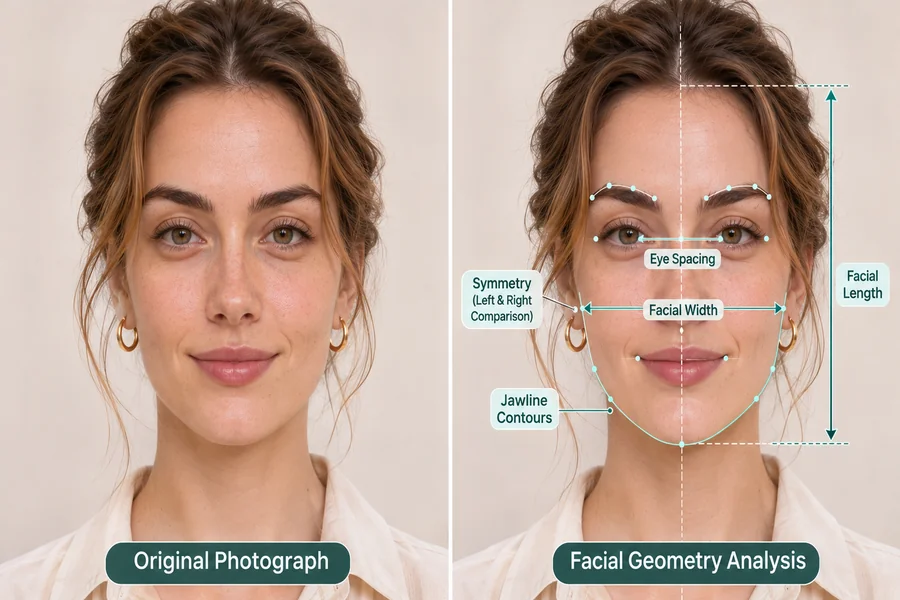
AI facial analysis identifies visible facial characteristics and examines their spatial relationships.
These measurements may include distances between facial features, facial width and length, eye spacing, jawline contours, and symmetry between the two sides of your face.
Review Your Attractiveness Score
Rather than focusing exclusively on the final number, consider what individual measurements reveal about your facial structure. This approach makes the experience more informative than simply assigning yourself a beauty rating.
Understanding Your Attractiveness Score on the Beauty Scale
AI beauty calculators commonly present results using numerical scales, such as a 1–10 attractiveness scale or a 0–100 beauty score.
Higher scores generally indicate closer alignment with the particular characteristics favored by the scoring model. Lower scores indicate less alignment with those criteria.
However, there is no universally accepted average attractiveness score or scientifically established threshold separating attractive and unattractive faces.
Different AI tools may generate different ratings for the same photograph because their measurement methods and scoring criteria vary.
What Does an AI Attractiveness Test Actually Measure?
Facial Symmetry
Facial symmetry describes how closely the left and right sides of your face resemble each other.
An AI beauty scanner may compare corresponding features, including your eyes, eyebrows, cheekbones, and jawline.
Although symmetry can influence perceived attractiveness, natural asymmetry is common. Slight differences between your eyebrows or the shape of your eyes contribute to your individual appearance.
Facial Thirds and Fifths
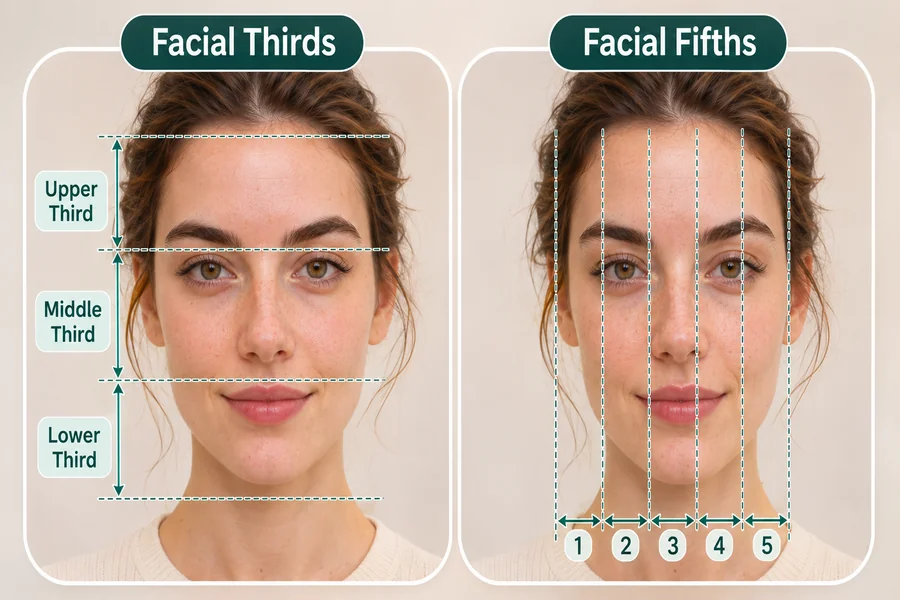
Facial thirds divide the face vertically into three regions:
- Upper third: hairline to eyebrows.
- Middle third: eyebrows to the base of the nose.
- Lower third: base of the nose to the chin.
Facial fifths divide the face horizontally into five approximate sections, traditionally using eye width as a reference.
These measurements help describe facial proportions, but perfectly equal divisions are not necessary for an attractive appearance.
Golden Ratio and Jawline Definition
The golden ratio, approximately 1.618, is a mathematical relationship frequently discussed in facial aesthetics.
Some beauty calculators compare facial measurements with this ratio to explore proportional relationships. However, the golden ratio is not a universal formula for beauty.
Jawline definition, chin shape, and midface proportions are additional characteristics that can influence how facial structure is perceived.
Eye Shape and Canthal Tilt
Canthal tilt describes the angle between the inner and outer corners of the eyes. It can be positive, neutral, or negative.
Together with eye shape, spacing, and eyebrow position, this characteristic contributes to the appearance of the eye area.
Facial expressions can temporarily change how these features look. If you are wondering whether your features work together, Facefy’s Am I attractive test offers a starting point for exploring facial harmony.
What an AI Beauty Test Cannot Measure
Physical appearance represents only one aspect of attraction. Other influential factors include confidence, personality, humor, communication skills, emotional maturity, personal style, and body language.
Cultural influences and individual preferences also shape how people perceive beauty. Someone who receives a moderate AI attractiveness rating may be considered exceptionally attractive by another person.
A static photograph cannot capture the warmth of a genuine smile, the energy of a conversation, or the connection between two people.
How to Get a More Reliable Attractiveness Score
Consistency matters when comparing AI-generated beauty scores. Use the same camera, similar lighting, and a consistent head position when taking photographs.
Avoid close-up, wide-angle selfies because they can exaggerate certain facial features. Keep your photograph sharp and ensure that shadows do not obscure your face.
If two photographs produce different results, this does not necessarily indicate a change in your actual appearance. Differences in image quality and positioning may explain the variation.
How to Use Your Beauty Score in a Healthy Way
An attractiveness test can be useful for exploring your appearance and making informed personal styling decisions.
For example, understanding your facial proportions may help you choose hairstyles that complement your features. Facefy’s AI Hairstyle Finder offers a practical way to explore different hairstyles while considering your facial structure and styling preferences.

You can also experiment with glasses, eyebrow styling, facial hair, and different hair lengths.
The objective should be finding styles that make you feel comfortable and confident, rather than repeatedly testing your appearance to achieve a higher score.
Can You Improve Your Attractiveness Score?
While characteristics such as bone structure and eye position are relatively stable, several everyday choices can influence your overall appearance.
Regular grooming, suitable hairstyles, adequate sleep, skincare, and well-chosen clothing can help you present yourself in a way that reflects your personality.
Photography techniques also influence your estimated beauty score. Better lighting and a more natural camera distance may produce a more representative image without changing your actual facial features.
Focus on practical, sustainable changes that support your well-being instead of pursuing an arbitrary beauty standard.
Frequently Asked Questions
Is my attractiveness test result permanent?
No. Results may vary depending on facial expressions, lighting, camera angles, image quality, and changes in your appearance over time.
Can AI accurately determine how attractive I am?
AI can estimate measurable facial characteristics, but it cannot objectively determine attractiveness or predict everyone’s personal preferences.
What is considered a good attractiveness score?
A higher score indicates closer alignment with a particular scoring model. There is no universally recognized good or average attractiveness score.
Can AI attractiveness tests be biased?
Yes. Training data, measurement criteria, and underlying beauty assumptions can introduce bias. Results should never be used to establish superiority between different ethnicities or facial characteristics.
Does facial symmetry determine attractiveness?
Symmetry is one characteristic that may influence perceived attractiveness. However, facial expressions, individual features, personality, and personal preferences are equally important considerations.
Facefy provides a useful starting point for understanding your facial appearance, but no beauty calculator can fully capture what makes you attractive.