
How To Plan A Heavy-Duty Diesel Engine Repower Without Costly Fitment Surprises
Key Takeaways
- Plan the repower around the machine’s requirements, not a replacement engine’s advertised horsepower.
- Verify duty rating, torque curve, operating speed, dimensions, mounts, cooling capacity, and controls before placing an order.
- Budget for adapters, hoses, wiring, exhaust work, fluids, labor, testing, and downtime, not just the engine assembly.
- Confirm emissions requirements and retain documentation before modifying or returning equipment to service.
- Design for future maintenance access, parts availability, and technician support.
A diesel repower can keep a structurally sound machine productive when the original engine has major damage, poor parts support, or recurring reliability problems. It is not, however, simply an exercise in choosing an engine with the same horsepower number. A replacement must work with the driveline, cooling package, controls, exhaust system, operating environment, and service needs of the equipment.
For example, evaluating a CAT 3306 engine involves more than confirming that it will physically enter the engine compartment. The buyer should identify the precise application, arrangement, accessory configuration, flywheel housing, intake and exhaust locations, and the components that will be retained from the existing installation.
Why Repower Planning Matters
A well-planned repower may extend equipment life and avoid the cost of replacing an entire machine. Poor planning creates the opposite result. Custom-mount fabrication, incompatible bell housings, inadequate radiator capacity, inaccessible filters, and unexpected wiring changes can halt a project after the old engine has already been removed.
The best decision depends on the machine’s overall condition and its future role. Inspect the frame, transmission, hydraulic pumps, generator ends, axles, and attachment systems before committing funds. If several major systems are near failure, an engine replacement alone may not be the most economical path.
Start With The Machine
Create a project file before requesting quotes. Record the make, model, serial number, build year, current engine serial number, and any prior modifications. Photograph the engine bay from all sides, including mounts, hoses, wiring connectors, exhaust routing, radiator supports, and service doors.
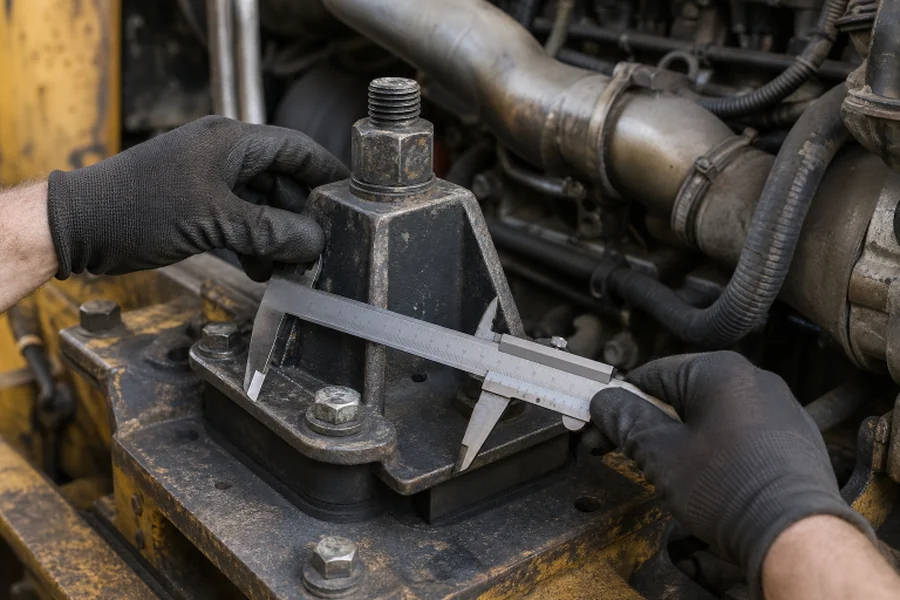
Measure usable length, width, height, and clearance above and around the engine. Document mount locations, crankshaft centerline, starter position, flywheel housing, clutch or torque-converter connection, hydraulic-pump drives, and accessory belts. Inspect mounts for damage, chassis attachment points for cracking or corrosion, and fuel lines for contamination or deterioration.
Match Power To The Duty Cycle
Published peak horsepower is only one selection factor. A machine that works continuously under a steady load needs an engine rated for that duty, whereas a loader, scraper, or crane may need torque characteristics suited to frequent load changes. Compare the torque at the engine speeds where the machine normally operates, not only the highest number on a specification sheet.
Build a simple duty-cycle description: typical load, peak load, hours per day, expected engine speed, ambient temperature, altitude, dust exposure, grades, and payload. More power is not automatically better. It can increase heat rejection and drivetrain loading beyond what the radiator, transmission, axles, or structure was designed to handle.
Check Physical Fitment
Confirm the complete installed envelope of the replacement engine, including the turbocharger, manifolds, filters, fan drive, starter, alternator, and aftertreatment components, where applicable. Compare mounting bolt patterns and account for adapter plates or fabricated brackets only after confirming that the chassis can safely support them.
- Check the compatibility of the flywheel housing, flywheel, clutch, flexplate, and transmission.
- Verify crankshaft centerline and driveline alignment.
- Confirm that the intake, exhaust, coolant, and fuel connections can be routed without kinks or exposure to heat.
- Leave clearance to remove filters, belts, injectors, and other service items later.
- Review weight distribution and lifting access before installation day.
Review Cooling, Fuel, Intake, And Exhaust Systems
A higher-output engine may require a larger radiator, a different fan, a charge-air cooler, improved shrouding, or more airflow through the compartment. Review hose diameter, pressure ratings, expansion-tank placement, coolant capacity, and fan-to-radiator clearance. Heat management deserves the same attention as physical dimensions.
Fuel supply and return lines must provide adequate flow and clean fuel. Replace questionable hoses, inspect tanks for debris or water, and use filtration appropriate to the engine’s fuel-system requirements. In dusty environments, confirm that the air cleaner and intake plumbing can protect the engine without creating excessive restriction. Route exhaust away from wiring, hydraulic hoses, combustible material, and operator areas.
Controls, Electronics, And Compliance
Modern repowers involve integrating electrical and electronic components, necessitating the identification of gauges, sensors, circuits, and controls. Consideration must be given to whether new modules, harnesses, instrumentation, diagnostic access, or control panel changes are needed. Compliance with regulations, especially for nonroad, highway, marine, and other regulated uses, is crucial before purchase. The EPA provides information on emissions rules, which vary by engine and equipment type. It is imperative to maintain emissions-related equipment and keep detailed records with the machine file. Additionally, installation presents safety risks. Before technicians begin work, isolate energy sources and use procedures consistent with controlling hazardous energy during servicing. Qualified personnel should test starter operation, shutdown functions, charging voltage, warning indicators, oil pressure, coolant circulation, and the leak-free condition of fuel and exhaust connections.
Costs And Installation Planning
Compare the total project cost rather than the engine price alone. Include freight, rigging, storage, adapters, mounts, radiator work, fan components, hoses, belts, filters, fluids, intake parts, exhaust fabrication, wiring, controls, labor, inspection, and machine downtime. Also consider future fuel use, parts availability, local service capability, and the cost of rental equipment while the machine is unavailable.
A practical installation plan follows a clear sequence:
- Inspect, photograph, measure, and document the machine.
- Define required power, torque, speed range, and duty cycle.
- Confirm fitment and supporting-system requirements for candidate engines.
- Verify compliance needs and obtain a written parts-and-labor scope.
- Schedule removal, fabrication, installation, testing, and follow-up inspection.
- Perform a controlled initial run, then recheck fluid levels, fasteners, belt tracking, leaks, and fault codes.
Mistakes To Avoid And Common Questions
What Are The Most Common Repower Mistakes?
Common mistakes include selecting by horsepower alone, ordering before measuring, assuming the old radiator is sufficient, overlooking transmission ratios, reusing damaged hoses or mounts, and failing to leave room for future service. Another costly error is starting the engine without verifying oil pressure, coolant flow, safe shutdown, and the absence of leaks.
Is A Higher-Horsepower Engine Always Better?
No. Excess power can add heat, increase fuel consumption under some operating conditions, and overstress downstream components. The right engine is the one that meets the real workload while remaining compatible with the machine’s cooling, driveline, and structural limits.
What Should Be Collected Before Requesting A Quote?
Provide the machine and engine serial numbers, photos, bay measurements, current engine arrangement, duty-cycle details, required accessory drives, transmission or pump information, and known problems with the existing installation. Detailed information produces a more useful quote and reduces fitment surprises.
Conclusion
A heavy-duty diesel repower is a complete equipment project. By defining the machine’s workload, documenting every connection point, checking supporting systems, planning controls and compliance, and budgeting for the entire installation, owners can make a replacement decision with fewer delays and fewer unexpected costs.


