
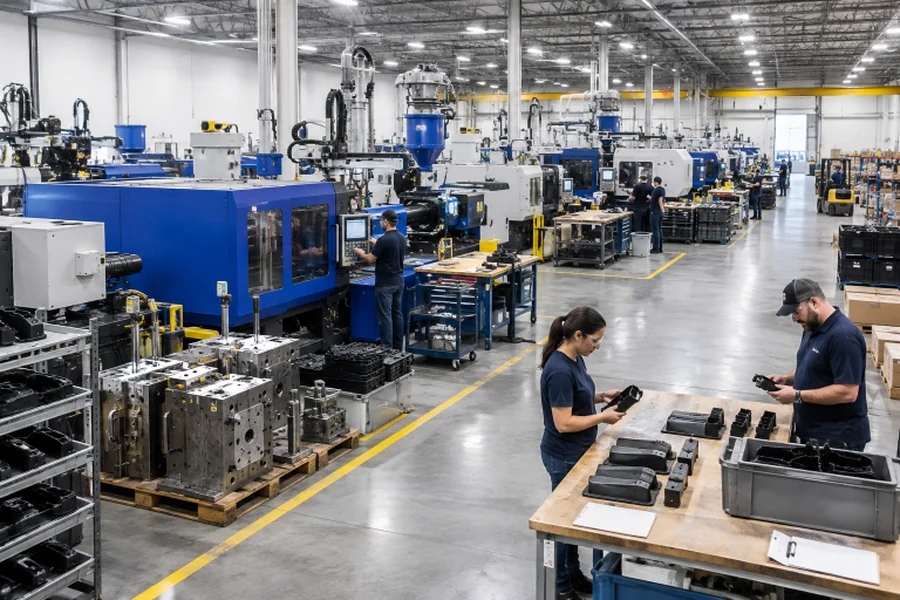
How to Choose a Plastic Manufacturing Process in Neodesha, Kansas
Key Takeaways
- Choose a plastic manufacturing process based on part requirements, production volume, material performance, and budget.
- Compare injection molding, thermoforming, CNC machining, rotational molding, extrusion, and additive manufacturing based on their capabilities and limitations.
- Select materials according to strength, temperature exposure, chemical resistance, UV exposure, and intended use.
- Review design details, tooling costs, tolerances, finishing needs, and production timelines before finalizing the design.
- Consider long-term costs, future production growth, and quality requirements rather than focusing only on the initial quote.
- Work with an experienced manufacturing partner, such as Neodesha Plastic Inc, early to identify potential issues and support reliable production.
Choosing the right plastic manufacturing process begins with the part’s job, not with the process a team has used before. For companies developing products in southeast Kansas, Neodesha Plastic Inc. can be part of early conversations about manufacturability, materials, tooling, and repeat production before expensive design decisions become difficult to reverse. A well-matched process can support reliable quality, reasonable lead times, and a sustainable unit cost. A poor match can create unnecessary tooling expense, excess material waste, cosmetic defects, or production delays. This matters for Kansas-made components that may need to perform through hot sun, changing temperatures, moisture, handling, transportation, or demanding industrial use.
Why Process Selection Matters
The manufacturing method affects far more than the initial quote. It shapes part consistency, allowable geometry, material options, production speed, finishing needs, and the amount of upfront investment required. Plastics manufacturing connects material behavior, mold design, machine settings, and inspection practices. Programs that teach plastic materials, manufacturing methods, and mold design reflect how closely those decisions are connected. The least expensive option at the beginning is not always the least expensive over the life of a product. A low-cost prototype method may be ideal for testing, yet become inefficient once orders grow. Process selection should happen before the design is finalized, when changes to walls, corners, fastening features, and tolerances are still manageable.
Start With Part Requirements
Every selection decision should begin with a clear part brief. Before requesting quotes, define the following:
- What the part must do and how it connects with other components.
- Its overall size, shape, weight, hollow areas, and detailed features.
- The expected annual volume, including prototypes and replacement parts.
- Exposure to impacts, heat, chemicals, UV light, friction, or outdoor conditions.
- Function-critical tolerances and required surface appearance.
- The deadline for samples, approvals, and full production.
Compare Common Plastic Manufacturing Processes
Injection Molding
Injection molding is often a strong option for repeatable medium- and high-volume parts. It can produce detailed features such as ribs, bosses, clips, and textured surfaces in one cycle. The trade-off is the cost and lead time of building a mold, although the per-part cost can decline as production volume rises.
Thermoforming
Thermoforming shapes heated plastic sheet over or into a tool. It is useful for many larger, lightweight parts, covers, trays, and enclosures. Tooling can be simpler than that of a complex injection mold, but wall thickness can vary, and formed parts often need trimming after forming.
CNC Plastic Machining
CNC machining is valuable for prototypes, fixtures, and low-volume components, especially when tight features or production-grade stock materials are needed. Because material is removed from a block or sheet, waste and machine time can make it less economical for large quantities.
Rotational Molding, Extrusion, and Additive Manufacturing
Rotational molding is well-suited to large, hollow, seamless products such as tanks and rugged housings, though its cycle times are generally slower. Extrusion is designed for continuous profiles, including tubes, sheet, film, and seals, rather than individual three-dimensional shapes. Additive manufacturing helps teams evaluate fit, form, and complex geometry before committing to tooling, but material selection, finish, strength, and throughput vary by printing method.
Match the Process to Production Volume
- One to several dozen parts: Consider 3D printing, CNC machining, or other prototype-oriented methods.
- Small to mid-sized batches: Compare short-run molding, thermoforming, machining, and rotational molding based on geometry.
- Large production runs: Injection molding or extrusion may provide stronger unit economics when the design fits the process.
Do not estimate volume based solely on the first purchase order. Include development samples, product testing, service parts, expected growth, scrap allowances, and possible future revisions. The right process for a launch quantity may not be the right process after a product gains traction.
Choose the Right Material
Resin selection should be based on real service conditions rather than price alone. Review impact resistance, stiffness, flexibility, temperature exposure, chemical contact, wear, UV resistance, color, texture, and any applicable food-contact, medical, or flame-performance requirements. Commodity plastics can be practical for many everyday components, while engineering plastics and reinforced grades may be appropriate when higher strength, heat resistance, or dimensional stability is necessary. Material names alone are not enough. Grades within the same polymer family can differ because of additives, colorants, reinforcements, recycled content, or processing characteristics. Ask for the exact proposed grade and confirm that it fits the intended application.
Review Design for Manufacturing
A design-for-manufacturing review can identify problems before a mold or fixture is built. Keep wall thickness reasonably consistent, add draft where molded parts must release from tooling, round sharp internal corners, and avoid undercuts unless they provide important function. Specify tight tolerances only where they affect fit or performance. A housing may look simple in CAD but still create production issues. Uneven walls can cool differently, tight internal corners can concentrate stress, and poorly located mounting features can complicate mold construction or assembly. Reviewing shrinkage, warpage, material flow, inserts, fasteners, and secondary operations early helps avoid costly corrections later.
Consider Tooling, Lead Time, and Quality
Compare the complete timeline: design review, prototype development, tool design, tool construction, first articles, inspection, corrections, approval, and repeat production. Ask who owns the tool, how revisions are priced, how it is maintained and stored, and what expected production demands it can support. Quality requirements should also be measurable. Define critical dimensions, allowable cosmetic variation, color, gloss, texture, inspection methods, and any trimming, printing, coating, bonding, or assembly steps. Process efficiency remains an important manufacturing concern, and research on reducing energy demand in plastic production underscores the need for careful attention to material and process choices.
Use a Process Selection Checklist
Provide the same complete information to every potential manufacturing partner so quotes can be compared on equal terms:
- Part drawings, dimensions, weight, and CAD files
- Expected annual volume and target unit cost
- Material grade and performance requirements
- Critical tolerances, finish, color, and texture
- Tooling budget and prototype needs
- Assembly, packaging, inspection, and documentation requirements
- Required delivery date and expected product life
Conclusion
For Neodesha and Southeast Kansas product teams, the strongest plastic manufacturing choice is the one that fits the entire product life cycle, from initial design and prototyping to production, quality control, and future demand. Start by identifying the part’s actual functional requirements, including its shape, size, strength, durability, and intended operating environment. Then balance these needs with expected production volume, material performance, tooling investment, dimensional tolerances, finishing requirements, and delivery goals. Thermoforming and injection molding offer different advantages, so the decision should reflect the specific application rather than relying on price or production speed alone. It is also worth considering how easily the design can be modified, whether production can scale with demand, and what maintenance or quality checks may be needed over time. Discussing these details with an experienced manufacturing partner can help reveal potential limitations before they become expensive problems. Careful process selection at the design stage can protect the budget, support consistent product quality, reduce avoidable delays, and create a more dependable path from concept to finished part.


