
How Small Brands Can Compete With Big Players on Social Media in 2026
You are running a small brand with a fraction of the budget of major competitors. Nike spends millions on social media. Your brand spends thousands. Nike has a team of 20 marketing professionals. Your brand has one person managing everything. Nike has millions of followers. Your brand has thousands. By every metric of scale, Nike wins. By every metric of resources, Nike wins. By conventional thinking, you cannot compete. But conventional thinking is wrong. Small brands have advantages big brands cannot replicate. Small brands can compete with big players. Small brands can win against bigger budgets. The question is not whether small brands can compete. The question is whether small brands understand their advantages and deploy them strategically.
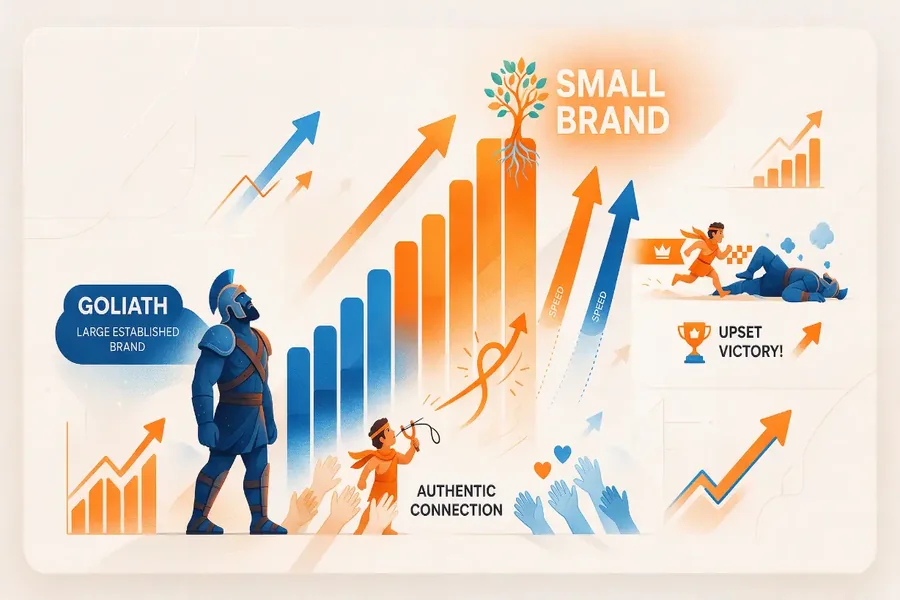
The social media landscape has fundamentally shifted. Scale is no longer the only competitive advantage. In fact, scale has become liability in many ways. Big brands are slow. Big brands are bureaucratic. Big brands cannot move fast. Big brands cannot be authentic. Big brands cannot focus on niche communities. Small brands can do all of these things. Small brands are fast. Small brands are agile. Small brands are authentic. Small brands can focus on specific communities. Small brands can win by playing a different game. This is the small brand playbook for 2026.
Advantage 1: Speed and Agility – Respond Faster Than Big Brands
The Scale Trap of Large Brands
Big brand wants to post something on social media. Post goes through: social media manager, marketing director, brand manager, legal review, executive approval. This process takes 1-2 weeks. By the time post goes live, moment has passed. Trend is over. Conversation has moved on. Big brand is always late. Small brand identifies trend. Posts same day. Captures moment. Builds engagement. While Nike is getting approval, your brand is trending. This speed advantage is real. This agility advantage is measurable. Small brands trend faster than big brands because small brands move faster.
Real-Time Marketing Advantage
Real-time marketing requires speed. When news breaks, when trend emerges, when cultural moment happens, small brands capitalize immediately. Big brands cannot. By the time big brand’s approval process finishes, moment is gone. Moments are where viral engagement happens. Small brands capture moments. Big brands miss moments. This is not theory. This is observable pattern across all platforms. Trending topics are dominated by small brands and individuals who moved fast, not by big brands with approval processes.
Advantage 2: Authenticity – Be Real in a Sea of Polished
Audience Authenticity Fatigue
Big brands are professionally polished. Every post is edited. Every photo is perfect. Every message is tested. This is production. This is corporate communication. Audiences are exhausted by perfection. Audiences crave authenticity. Audiences want to see humans, not corporations. Small brands are human. Small brand founder speaks directly to audience. Small brand shares failures alongside wins. Small brand shows the messy reality of business. Audiences connect with authentic. Audiences ignore perfect. In 2026, authenticity is competitive advantage. Small brands own authenticity. Big brands fake it.
The Trust Factor
Small brand has face. Small brand has name. Small brand has story. Audience knows founder. Audience trusts founder. Founder is vouching for product. This personal trust is unbreakable. Big brand is faceless corporation. Big brand has no personal connection. Big brand is selling, not connecting. Audiences buy from people they trust. Small brands have trust. Big brands have scale. In head-to-head competition, trust beats scale. This is why small brands convert higher than big brands at equal reach. Trust multiplies conversion. Scale without trust generates views without buyers.
Advantage 3: Niche Domination – Own Your Specific Community
The Big Brand Generalist Trap
Big brands must appeal to everybody. Nike appeals to athletes, to fashion people, to gym-goers, to casual wearers. This broad appeal requires generic messaging. Generic messaging connects with nobody deeply. Big brands reach millions but own nothing. Small brands can go deep on specific niche. Small brand serves skateboard community, or yoga community, or indie entrepreneurs. Small brand becomes authority in that niche. Small brand becomes the go-to brand for that community. Niche domination beats broad reach. Loyal niche community generates more revenue than casual broad audience. Small brands own niches. Big brands own nothing but reach.
The Niche Advantage in Algorithm
Social algorithms reward consistency and relevance. Big brand posts about 50 different topics. Algorithm sees no consistent pattern. Reach is scattered. Small brand posts about one niche. Algorithm recognizes pattern. Algorithm shows content to people interested in that niche. Small brand content ranks better in niche searches. Small brand content gets higher engagement within niche. Algorithm rewards niche focus. Small brands get algorithmic advantage by being niche-focused. Big brands get algorithmic penalty by being broad.
Advantage 4: Engagement Rate – Higher Engagement Than Big Brands
The Engagement Paradox
Small brand with 10,000 followers achieves 5-10% engagement rate. Big brand with 10 million followers achieves 0.1-0.5% engagement rate. Small brand engagement is 10-50x higher. Why? Small followers are self-selected. They chose to follow because they care. Big followers are mixed. Many are passive, inactive, or there by accident. Quality of follower matters more than quantity. Small brands have quality followers. Big brands have quantity followers. Quality generates engagement. Quantity generates vanity metrics. Engagement is what drives results. Small brands win on engagement.
The Business Impact of Engagement
Engagement converts to sales. High engagement audience buys. Low engagement audience scrolls. Small brand with 10% engagement on 10,000 followers = 1,000 engaged people. Big brand with 0.1% engagement on 10 million followers = 10,000 engaged people. Big brand has 10x engaged audience. But this comparison is incomplete. Small brand audience is niche, focused, loyal. They buy. Big brand audience is broad, casual, window shopping. They scroll. When accounting for conversion rate, small brand engaged audience converts 5-10x better than big brand passive audience. Small brand wins on business results, not vanity metrics.
Advantage 5: Cost Efficiency – Compete on Budget, Not Spend
Paid Amplification ROI
Big brand spends $100,000 on ad campaign. Reaches 10 million people. Cost per reach: $0.01. Big brand gets cheap reach. Small brand spends $1,000 on ad campaign. Reaches 100,000 targeted people. Cost per reach: $0.01. Small brand gets same cost-per-reach. But small brand audience is targeted. Small brand audience has 5-10x higher conversion rate. Small brand $1,000 generates $5,000 revenue. Big brand $100,000 generates $500,000 revenue. On absolute terms, big brand wins. On efficiency terms, small brand wins. Small brand generates more revenue per dollar spent. This is why small brands can compete on budget they have. Efficiency beats raw spend.
The Organic Leverage
Small brand gets 10% engagement on $1,000 ad spend. This organic engagement compounds. Followers share. Audience recommends. Word of mouth spreads. Organic reach multiplies paid reach by 3-5x. Big brand gets 0.1% engagement on $100,000 spend. Organic reach is minimal. Paid reach is wasted. Small brand leverage converts paid into organic. Big brand converts paid into vanity. Small brands multiply every dollar spent. Big brands lose dollars to inefficiency. In a fair competition based on efficiency, small brands win.
Advantage 6: Community Building – Build Loyalty Big Brands Cannot Match
The Personal Connection Factor
Small brand founder responds to every comment. Small brand founder knows followers by name. Small brand builds community, not audience. Community is invested. Community defends brand. Community becomes advocates. Big brand cannot do this. Big brand has too many followers. Response is impossible. Big brand followers are not community. They are audience. Audience is passive. Community is active. Community drives growth. Small brand community spreads brand through recommendation. Big brand audience spreads brand through paid amplification. Recommendation is more effective than paid. Small brands win through community.
The Retention Advantage
Big brand loses 5-10% of followers monthly. Follower base is unstable. Growth requires constant new follower acquisition. Small brand loses 0-2% of followers monthly. Follower base is stable. Growth requires modest new follower acquisition. Retention is cheaper than acquisition. Small brand retention advantage is cost advantage. Small brand keeps followers. Small brand grows through quality, not churn. Big brand keeps churning. Big brand grows through spend, not loyalty. Over time, retention advantage compounds. Small brand base becomes increasingly stable and loyal. Big brand base remains volatile.
Advantage 7: Strategy Flexibility – Pivot Faster Than Big Brands
Experimentation Advantage
Small brand tests new content format. If it works, scale it. If it fails, try something else. This happens in weeks. Big brand tests new format. Gets data. Goes through approval process. Tests again. Makes decision. This happens in months. Small brand experiments 10 times while big brand experiments once. Some experiments fail. But small brand learnings multiply. Small brand finds winning formula. Big brand is still testing. Speed of experimentation is advantage. Small brands iterate faster. Fast iteration finds success faster.
Market Adaptation
Market shifts. Platform algorithm changes. Audience preferences evolve. Small brand adapts immediately. Big brand adapts slowly. Small brand takes 2 weeks to change strategy. Big brand takes 2 months. In fast-moving market, adaptation speed is survival advantage. Small brands survive change. Big brands get disrupted by change. This is why startups disrupt incumbents. Speed of adaptation beats inertia of scale.
Advantage 8: Personal Brand – Founder Is Marketing Channel
The Founder as Asset
Small brand founder has personal following. Founder is recognizable. Founder is brand ambassador. Founder is content creator. Founder’s personal audience amplifies brand message. Big brand executive has minimal personal following. Executive is not brand ambassador. Executive is not marketing channel. Big brand cannot leverage founder. Small brand amplifies through founder. Founder network becomes brand asset. This is free amplification. This is unscalable by big brands. Small brands win by monetizing founder brand.
How Small Brands Deploy These Advantages
Strategy 1: Own Your Niche
Pick specific community. Become authority in that community. Post consistently about niche. Engage deeply with niche followers. Build reputation as niche expert. Do not chase broad reach. Own niche instead. Niche gives you platform that big brands cannot compete with.
Strategy 2: Be Authentically You
Show up as human. Share wins and failures. Respond to followers personally. Build community, not audience. Let followers know founder. Trust compounds over time. Big brands cannot replicate this. You own authenticity.
Strategy 3: Move Fast
Identify trends. Post immediately. Run experiments. Iterate rapidly. Make decisions fast. Don’t wait for approval. Speed is advantage. Big brands are slow. You are fast. Use speed.
Strategy 4: Leverage Founder Brand
Build personal brand alongside business brand. Founder presence amplifies business. Founder followers become business followers. This is free amplification. Big brands cannot match this because executives do not have brands. You have brand. Leverage it.
The Real Competitive Advantage: Playing Different Game
Small brands cannot win playing big brand game. Small brands cannot outspend Nike. Small brands cannot reach Nike’s audience size. This is losing game. But small brands can win playing different game. Small brands can win on speed. Small brands can win on authenticity. Small brands can win on niche. Small brands can win on engagement. Small brands can win on efficiency. Small brands can win on loyalty. Small brands are not competing against Nike on Nike’s terms. Small brands are competing on small brand terms. On small brand terms, small brands win. This is the strategic shift that changes everything. Stop trying to compete like big brand. Compete like small brand. Deploy the advantages only small brands have. Strategy wins over budget. Speed wins over scale. Authenticity wins over polish. Niche wins over broad. This is how small brands beat big players in 2026. Understand your advantages. Deploy them strategically. Watch small brand win against bigger competition. Check out strategic growth solutions that help small brands amplify these natural advantages. Real growth services accelerate what small brands do naturally: build authentic communities, engage niche audiences, and leverage personal brand. Small brands with strategic amplification compound natural advantages into exponential growth. This is how small brands win. This is the playbook for 2026.


